1. What distinguishes TP·VAS from a fully bonded coating?
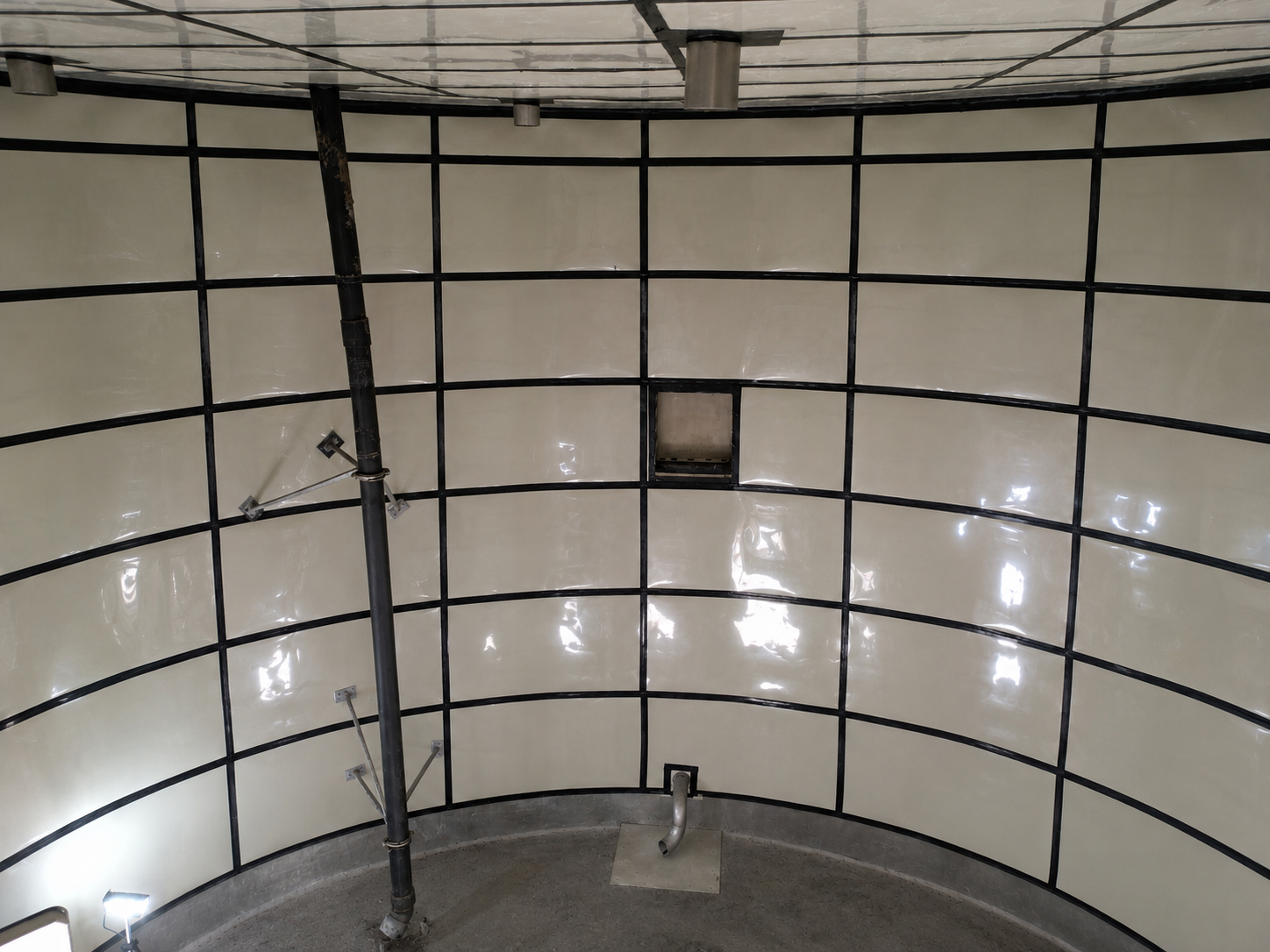
TP·VAS forms a separate protective layer which is mechanically fixed at defined locations rather than bonded across the entire concrete surface.
Protective function
The existing concrete remains the load-bearing structure. The PP-H lining separates it from the tank medium.
Consequence for the substrate
Dependence on full-area surface adhesion is substantially reduced. The concrete must nevertheless be sound enough at the selected anchorage locations.
2. Which components form the TP·VAS system?
The PP-H surface, fixing strips, elastic contact and sealing layer, flexible FPP bands and metallic fasteners have distinct functions.
PP-H lining plates
Normally 2.0 mm thick. They form the medium-facing chemical separation layer.
PP-H fixing strips and rings
Typically 5 mm thick and approximately 50–100 mm wide. They fix the lining and help limit possible movement of substances behind it.
Elastic contact and sealing layer
The documented configuration uses Sikaflex TS Plus to accommodate substrate irregularities, help limit pathways and decouple local stress. Product-specific application conditions apply.
FPP welding bands
Normally 1.5 mm thick, about 80–200 mm wide and cut from Solmax ProFlex geomembranes. They cover fixing zones and connections and accommodate local movement.
3. How are all metallic fixing components protected?
All metallic fasteners are fully covered on the medium-facing side with welded thermoplastic FPP bands. No metal fixing component is intended to remain exposed to the aggressive tank medium.
Constructive protection
The fixing components are located behind the lining. After anchorage, the fixing zones are covered by FPP welding bands, which are thermoplastically incorporated into the lining.
Material selection
Corrosion-resistant V4A stainless-steel fasteners are used, including grades such as 1.4401, 1.4404 or 1.4571. Material resistance is an additional safeguard; the design does not rely on direct exposure of the metal to the medium.
The statement describes the properly installed, intact system and its intended operating condition.
4. How is the lining anchored in existing concrete?
Mechanical fasteners transfer loads into sufficiently competent concrete and position the PP-H fixing components.
Existing damage
The surface of an existing biogas tank may be chemically affected below the visible face. Anchors must extend beyond unsuitable material and provide adequate capacity in the remaining concrete.
Typical depths
The system documentation identifies typical anchorage depths of 50 mm, or 75 mm where increased requirements apply. They are not universal design values; concrete condition and actual load requirements govern selection.
5. How does TP·VAS accommodate thermal movement?
The lining is not rigidly bonded across the full wall. Concrete movement is therefore not directly transferred to the plates as full-area tensile strain.
Daily temperature effects
Solar radiation, shading, daytime heat and night cooling can create different temperatures across a concrete tank wall and cause movement.
Own thermal expansion
PP-H expands and contracts too. Plate arrangement, fixing details, joints and flexible FPP connecting zones must be designed to accommodate this behaviour.
6. Must the concrete be completely dry before installation?
No. Positioning and fixing the PP-H plates do not require a completely dry, full-area adhesive substrate.
Difference from coating work
Many liquid-applied coatings require controlled moisture, temperature and curing conditions to achieve adhesion. Plate fixing is not based on that full-area bond.
Local requirements remain
The contact and sealing layer, anchorage points and weld preparation still have their own application and quality requirements.
7. How do weather and access affect plate installation?
Plate positioning is less dependent on a fully dry concrete surface, but safe handling and the requirements of local materials remain important.
Rain and snow
Limited rain and wet concrete can be tolerated when working conditions allow. Snow does not create a full-area coating-curing requirement for the plates. Work is subject to safe access and the conditions necessary for welding and local sealants.
Wind
Strong wind is a practical concern: large sheets can be difficult to handle and must be secured.
Handling
The individual plates can generally be carried into a tank without crane handling of large membrane rolls.
8. Which thermoplastic welding procedures are used?
Qualified welding procedures are selected according to the material, detail geometry and intended connection.
| Procedure | Typical application |
|---|
| III-1 Hot-gas draw welding | Detail work, smaller welds and repairs |
| III-4 Hot-gas overlap welding | FPP bands, overlaps and surface connections |
| III-6 Hot-gas extrusion welding | Formed parts, penetrations and special connections |
The system documentation references qualification and procedures according to DVS 2212-3. The actual method and inspection depend on the specific work.
9. How are possible pathways behind the lining limited?
PP-H fixing strips and rings contribute to limiting possible paths for substances behind the protective layer.
Local separation
Additional strips can divide an area into smaller sections where project conditions justify this. This can help limit and locate the consequences of local damage.
Connections matter
Cover strips, pipe penetrations, wall connections and special details must work together with the protective layer.
10. Can the structure be inspected after installation?
Selected lining areas can be opened to inspect the underlying concrete and subsequently closed using appropriate thermoplastic welding techniques.
Inspection and maintenance were explicit development objectives of the system. Technical records of the installed details support future assessment.
11. Can damaged lining areas be repaired?
Local repairs and modifications can often be made directly on site without replacing the entire lining.
Whether repair is appropriate depends on the type and extent of damage, accessibility and the condition of surrounding material. PP-H components can be processed using welding methods customary in plastics fabrication.
12. What determines long-term durability?
Durability depends on the complete construction, not just the chemical resistance of the PP-H plate.
Relevant factors include material compatibility, temperature, mechanical load, correct anchorage, thermal expansion, quality of welded connections, complete coverage of metallic fixing components, limitation of migration paths and future inspection and repair possibilities.
No universal service life can be specified independently of the operating medium, construction quality, temperature and maintenance.